Laparoscopic Surgery
A laparoscopic surgery can be performed as a diagnostic or treatment procedure, depending on your medical condition. Dr. Kiran is renowned for providing laparoscopic surgery for gynecological and fertility issues.
Why Choose Dr. Kiran Usman for Laparoscopy?
Choosing the best laparoscopic surgeon isn’t about trusting any name that appears online. Dr. Kiran considers an individualized approach when deciding whether surgery is an appropriate treatment choice for different cases.
With 15+ years of experience performing diagnostic and operative laparoscopic surgeries, Dr. Kiran Usman has become one of the leading names in Lahore-based fertility clinics. She has completed MBBS, FCPS, and achieved many international certifications from well-recognized universities in Pakistan and the UK.
Laparoscopic Surgery Services
Dr. Kiran is a qualified and experienced laparoscopic surgeon, specializing in minimally invasive gynecological procedures for many women’s reproductive health issues, such as endometriosis, ovarian cysts, fibroids, uterus removal, and more.
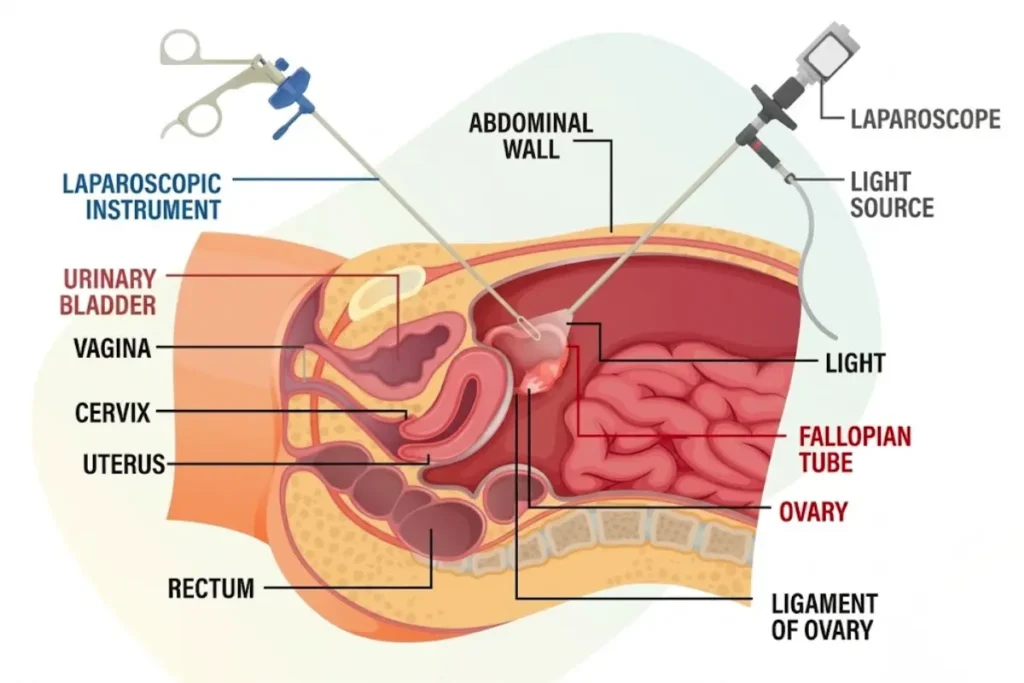
A laparoscope refers to a thin, lighted device that allows the surgeon to examine, as well as operate on, the inside of your abdomen or, in women, the pelvic area. The surgery is minimally invasive and requires a single main incision around the belly button, through which a laparoscope is inserted into the abdomen or pelvis.
If it’s purely diagnostic, a single incision may be enough to examine the organs. However, if additional procedures are performed during the same operation, the surgeon might make more small incisions to insert other specialized instruments.
The camera attached to the laparoscope generates images on the monitor in the operating room. This allows the surgeon to get live, clear pictures of your internal organs without having to make a large abdominal incision.
Common Gynecological Conditions Treated with Laparoscopy
Blood tests, ultrasound scans, and other imaging tests aren’t always enough to get a proper diagnosis. When a surgeon can’t figure out the underlying medical issue through these tests, they might advise laparoscopy. It may not be routinely done, but it can be an effective diagnostic or treatment choice for selected patients.
Infertility Evaluation
A keyhole surgery can be used to investigate the cause of infertility. It’s advised when your doctor suspects blocked fallopian tubes, pelvic adhesions, abnormal uterine shape, endometriosis, or scar tissues that might affect reproductive organs.
It can be an effective diagnostic procedure for tubal blockages or scar tissues around the tubes that might prevent sperm from reaching the egg. Note that laparoscopic surgery isn’t the first test advised to every woman facing infertility. It’s considered when less-invasive diagnostic tests can’t assess the woman’s pelvic function effectively.
Endometriosis Treatment
Tissues similar to the lining of your uterus can grow in unusual areas, such as the pelvic lining, on the surface of the ovaries, or near the fallopian tubes. The tissue sheds just like your uterine lining during menstruation, but the blood has nowhere to go. This can cause pelvic irritation and inflammation.
Endometriosis can also interfere with your fertility, depending on its location. A keyhole surgery can detect endometriosis lesions, adhesions, and other relevant abnormalities. If suitable, the surgeon may remove the lesions during the same operation to provide relief.
Ovarian Cyst Removal
The small fluid-filled sacs in your ovaries are almost always normal, but certain types might require further investigation. Laparoscopic surgery is recommended when you have a large ovarian cyst, which looks abnormal, affects your ovarian function, or has unusual characteristics. During the surgery, the cyst is removed while preserving as much healthy ovarian tissue as possible.
PCOS-Related Procedures
If medication for PCOS has not helped, a surgeon may recommend laparoscopic ovarian drilling, a procedure that carefully reduces androgen-producing ovarian tissue, thus restoring your ovarian function. However, it’s not a routine PCOS treatment and is only considered after weighing its benefits with potential risks.
Fibroids Treatment
The benign tissue growth in the muscular wall of your uterus, commonly called fibroids, can be asymptomatic or might cause pelvic pain, pressure, heavy bleeding, and in some cases, difficulty conceiving. Symptomatic fibroids can be removed surgically, through a minimally invasive laparoscopic procedure, but larger fibroids or those located in complex locations may require another surgical approach.
Ectopic Pregnancy Management
Ectopic pregnancy is when pregnancy, which is supposed to grow in the uterus, implants in other places, most commonly the fallopian tubes. Whether you need medication or surgical treatment depends on your HCG levels. The pregnancy tissue can be removed with laparoscopic surgery.
Depending on the damage to the tubes, they might be preserved or removed along with the pregnancy tissue. However, if the tube has already ruptured or there’s a sign of heavy internal bleeding, an emergency laparotomy may be performed to remove the tissue and tube (if appropriate), and control bleeding.
Why Consider Laparoscopic Surgery
The smaller scar itself offers a big cosmetic advantage for patients concerned about their appearance. Not only that, but smaller scars generally mean less bleeding, less impact on the abdominal wall, and consequently faster recovery. Here are some potential benefits of laparoscopic surgery.
- Smaller, keyhole-sized incisions
- Less blood loss
- Less post-operative pain
- Short hospital stay
- Fast recovery
Many women undergoing this minimally invasive procedure return to their routine, gentle activities within a few weeks.

What to Expect from Laparoscopy Procedure
Before Surgery
A uterus laparoscopy surgery isn’t advised routinely. Your doctor will decide whether you are a good candidate for the procedure based on your medical history, diagnosis, medications you currently take, physical & gynecological examination, and anesthesia assessment.
Once it’s decided, your surgeon will explain the instructions regarding how to prepare. For example, you must avoid drinking water or eating anything several hours before the surgery. Wear loose-fitting clothes and arrange for a ride home.
During Surgery
Here’s what happens in the operating room.
- Anesthesia Administration: The surgeon administers general anesthesia, so you can sleep comfortably throughout the surgery.
- Incision: The surgeon makes a tiny incision near the belly button, or additional incisions on the abdomen, based on whether you have a diagnostic or operative laparoscopy.
- Carbon dioxide Gas: They slowly release carbon dioxide gas into your abdomen to create enough working space and get a clear, uninterrupted view of the internal organs.
- Examining the Pelvis: The surgeon inserts a laparoscope through the hole and examines your pelvic organs through the images created on the screen.
- Treatment: The underlying issue is treated based on the findings. For example, fibroids are detached from the muscular wall of the uterus, broken into smaller fragments, and removed using a specialized tool called a morcellator.
- Stitched Back: The incisions are closed with stitches.
After Surgery
You will be shifted to the recovery room after surgery. Your vitals are monitored, and the doctor will give medicines for pain and nausea. You will stay here until the effect of anesthesia wears off and you are stable.
You might get discharged on the same day or the next day, depending on the complexity of the surgery and the condition treated. You will get detailed post-surgical instructions, such as how to take care of the wound, which medicines to take, or when to contact your surgeon.
Recovery After Laparoscopic Surgery
The biggest advantage of a laparoscopic procedure is faster recovery. However, the timeline can vary depending on the exact procedure and its complexity.
For example, laparoscopic surgery for a simple diagnostic procedure involves a shorter recovery compared to operative laparoscopy for severe endometriosis or hysterectomy. In the meantime, you can expect these common post-surgical issues:
- Bloating
- Tenderness or mild pain around the incision site
- Nausea
- Abdominal discomfort
- Shoulder-tip pain
Get adequate rest, but also start walking to reduce post-operative complications. Do not start working out or doing any exercises until you get a green light from your surgeon. Also, avoid driving and sexual activity until you are completely healed.
Risks of Laparoscopic Surgery
Although it’s relatively less invasive than a traditional open surgery, it doesn’t come without risks. Here are some common risks associated with laparoscopic procedures.
- Infection
- Bleeding
- Blood clots
- Reaction to anesthesia
- Injury to the nearby organs, such as bowel, bladder, or blood vessels.
- An immediate need to convert it into an open surgery
The risks can be significantly reduced when you choose the best laparoscopic surgeon who has several years of experience performing laparoscopic surgery—both diagnostic and operative procedures.
Laparoscopy Surgery vs Open Surgery
| Basis | Laparoscopy | Open Surgery |
|---|---|---|
| Incision Type | Several small incisions | A single large cut |
| Access | Special instruments are used to access the pelvic organs | The surgeon accesses the internal organs directly through the cut |
| Level of Disruption | Causes minimal disruption to the abdominal wall | Excessive disruption to the abdominal wall |
| Recovery | Usually quick | Slow recovery |
| Scar Length | Leaves small scars | Leaves a larger scar |
If you are advised laparoscopic surgery for any gynecological or reproductive health issue, feel free to contact Dr Kiran Usman. We provide detailed information about the surgery, the before, during, and after instructions, as well as recovery details. Contact us now and book your first consultation to get a personalized treatment plan for gynecological issues or infertility.
Book Your ConsultationReviews
Our Happy Patiens
Read the experiences of people who trusted us with their fertility journey. Their words mean a lot to our team and inspire us every day.
EXCELLENT Based on 232 reviews
 Posted on Google
 Yousaf KhanMy wife had her laparoscopic surgery with Dr. Kiran Usman, and everything went smoothly. Dr. Kiran explained the procedure clearly and made her feel comfortable throughout. We truly believe she is one of the best laparoscopic surgeons in Lahore. Highly recommended.Posted on Google
 Abdul RehmanWe visited Dr. Kiran Usman yesterday for my wife’s laparoscopic surgery, and our experience was excellent. Dr. Kiran is very professional, caring, and explains everything clearly before the procedure. We felt completely comfortable throughout the treatment. She is truly one of the best laparoscopic surgeons in Lahore and a very skilled gynecologist doctor in Lahore. The staff at the clinic was also supportive and cooperative. Highly recommended for anyone looking for a trusted gynae specialist.Posted on Google
 Arsh AhmadDr. Kiran Usman is a knowledgeable, professional, and caring doctor. She listens patiently, explains everything clearly, and makes patients feel comfortable throughout the consultation. Her compassionate approach and attention to detail are truly appreciated. I highly recommend her to anyone looking for excellent medical care.Posted on Google
 Muzammil Ali JanSuch a nice doctor.Posted on Google
 Ayesha BasharatSincerely very happy with Doctor Kiran. After just one consultation my issue got resolved and I feel healthy again Alhumdulilah
Success Stories
Many women with different gynecological problems and fertility concerns have shared their positive experiences after consulting Dr. Kiran Usman.
You are just one step away from getting the right guidance and proper care for your fertility or reproductive health concerns. Book an appointment with Dr. Kiran now, and get answers to all your questions.
Evercare Hospital, D1 Commercial, NECHS Block D 1, Nespak Housing Scheme, Lahore, 54770

Our Location

Evercare Hospital, D1 Commercial، NECHS Block D 1 Nespak Housing Scheme, Lahore, 54770